
This is the picture almost nobody in America was allowed to look at twice, and the man in it has never been identified with certainty.
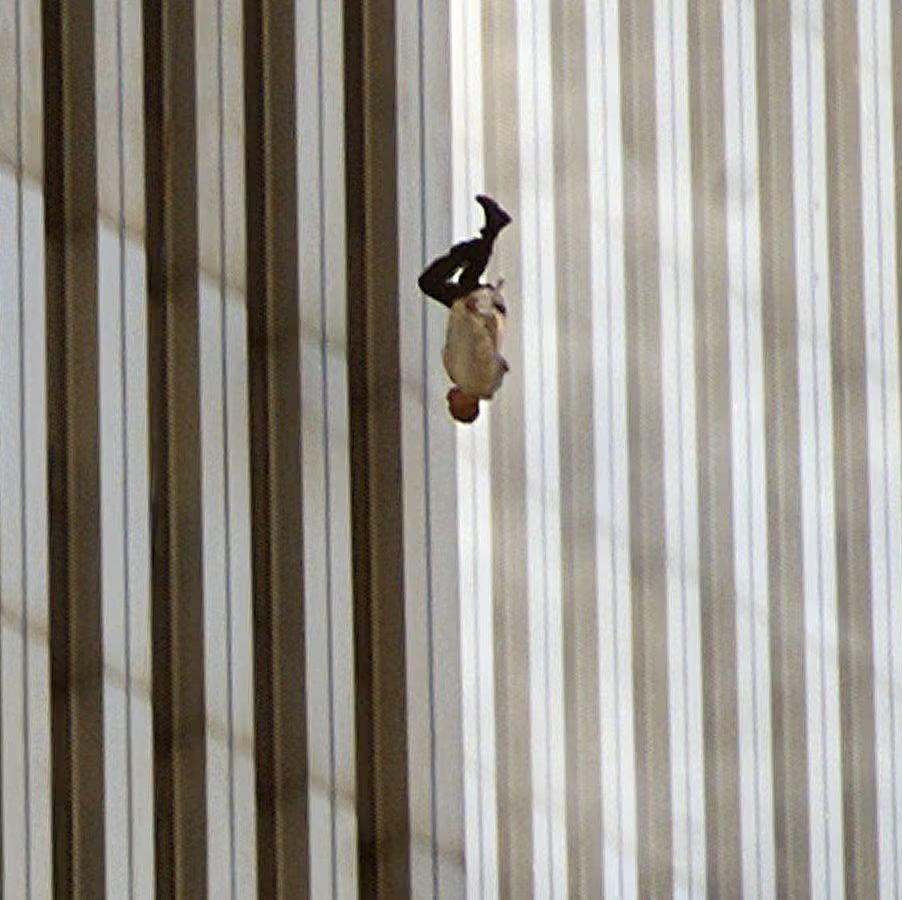
Richard Drew of the Associated Press took it at 9:41:15 a.m. on September 11, 2001, standing at West and Vesey Streets. A man in a white jacket
时政
(
twitter.com
)
This is the picture almost nobody in America was allowed to look at twice, and the man in it has never been identified with certainty.
Richard Drew of the Associated Press took it at 9:41:15 a.m. on September 11, 2001, standing at West and Vesey Streets. A man in a white jacket and dark trousers is falling head down along the face of the North Tower, arms at his sides, one knee bent, perfectly vertical against the building's silver lines.
It ran in the New York Times on September 12, on page seven. The reaction was immediate and furious. Readers called it ghoulish, cold blooded, sadistic. Papers that ran it apologized. The photograph essentially vanished from American media for years, at a time when the country was looking at nothing but footage of that morning.
Here is the first thing that is misunderstood about it. The man is not falling gracefully. It is one frame out of a sequence of twelve, and in the others he is tumbling and flailing the way a body does. Drew's camera caught a single quarter second in which he happened to look composed. The calm in that photograph is an accident of shutter speed.
Here is the second thing. He did not choose to die. He chose which way.
Above the impact zones, both stairwells were gone, the heat was reaching temperatures that steel does not like, and there was no way down and no way up. Roughly 200 people went out of those windows. Some jumped alone. Witnesses on the ground saw people holding hands on the way. One of them struck and killed FDNY firefighter Daniel Suhr on the street below the South Tower.
The New York City medical examiner was asked about this and was unambiguous. Not one of those deaths was ruled a suicide. Every death at the World Trade Center on September 11, 2001, including every person who came out of a window, is classified as a homicide. They were killed by the men who flew the airplanes. The office simply refused to use the word jumper.
The search for the man's name is its own story. A Canadian journalist first proposed Norberto Hernandez, a pastry chef at Windows on the World. His family rejected it with real anguish, partly because they are Catholic and the idea that he had jumped was unbearable to them. Tom Junod, working on his 2003 Esquire piece, went through the full twelve frame sequence and ruled Hernandez out.
The name that has stuck since is Jonathan Briley. He was 43, a sound engineer at Windows on the World on the 106th floor, the son of a preacher, a singer, asthmatic, tall and very thin. His body was found relatively intact. His brother Timothy, a police officer, identified him. His family recognized the bright orange shirt he habitually wore under his work clothes, and Michael Lomonaco, the executive chef at Windows on the World, said the same thing when he saw the sequence. In one of the frames, that orange shirt is visible pulled loose from the jacket.
It is probably him. It has never been confirmed, and it never will be.
Junod's conclusion has held up for twenty five years. The reason the picture was buried is not that it is gruesome, because it is not. There is no blood and no impact and almost no detail. It was buried because it is unbearable in a different way. It is one identifiable human being, alone, in the last seconds, and the country wanted the day to be about buildings and about firefighters and about flags.
Roughly 200 Americans were burned out of the windows of those towers that morning and almost none of them have names attached to how they died. The falling man stands in for all of them, and we still do not know which one he is.
点击图片查看原图

