
Tomorrow the 🇨🇳 mega embassy is going to be approved. We expect the decision to come as a Written Statement from Steve Reed MP. Weirdly, there's also a Home Office parliamentary statement planned, which will probably be about how we have cleared the embassy from a security point
时政
(
twitter.com
)
Tomorrow the 🇨🇳 mega embassy is going to be approved. We expect the decision to come as a Written Statement from Steve Reed MP. Weirdly, there's also a Home Office parliamentary statement planned, which will probably be about how we have cleared the embassy from a security point of view.
Long post about that:
Security Minister @DanJarvisMBE is likely to say the following in his statement. Here's why I don't agree with it. As usual, Government will be relying on MPs not having read all the planning documents (why would they?).
1. The 'consolidation' argument.
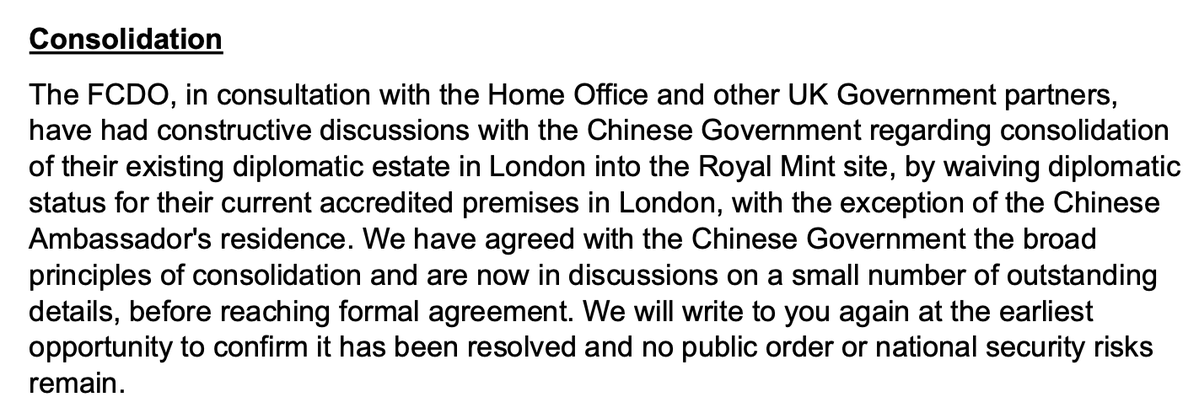
In Jan 25, @YvetteCooperMP and @DavidLammy wrote to the Planning Inspector. They said they had security concerns regarding the embassy plans, and wanted 7 Chinese Consular premises consolidated in the mega embassy site. In Feb 25, the Chinese said "no".
To @AngelaRayner's credit, her officials picked up on this in August, and asked the Home and Foreign Offices if they were cool with China's "no".
This accelerated negotiations between UK and China. Finally, China has agreed a 'framework' to consolidate these premises (First image, from Foreign and Home Office in August, 25)
But this does nothing to solve the security issues. Some in Government were trying to brief that "it would mean all the spies are in one place" (lol).
There are many more than 7 consular premises being operated by the Chinese State in London, as the Times reported a month ago. Second, this embassy is designed to accommodate hundreds more Chinese state employees. Is the argument *really* that hundreds more PRC state employees will be unable to interfere in UK life because they are based principally in Royal Mint Court? Hard to take this seriously as a student (and target) for Chinese state activity in the UK. This overlooks the key fact that PRC state influence isn't always - or even predominantly - illegal. But hundreds more state employees absolute WILL mean more influence and interference. Finally, the agreed consolidation can easily be revoked. A Note Verbale is not binding.
2. The 'historic ruins' argument.
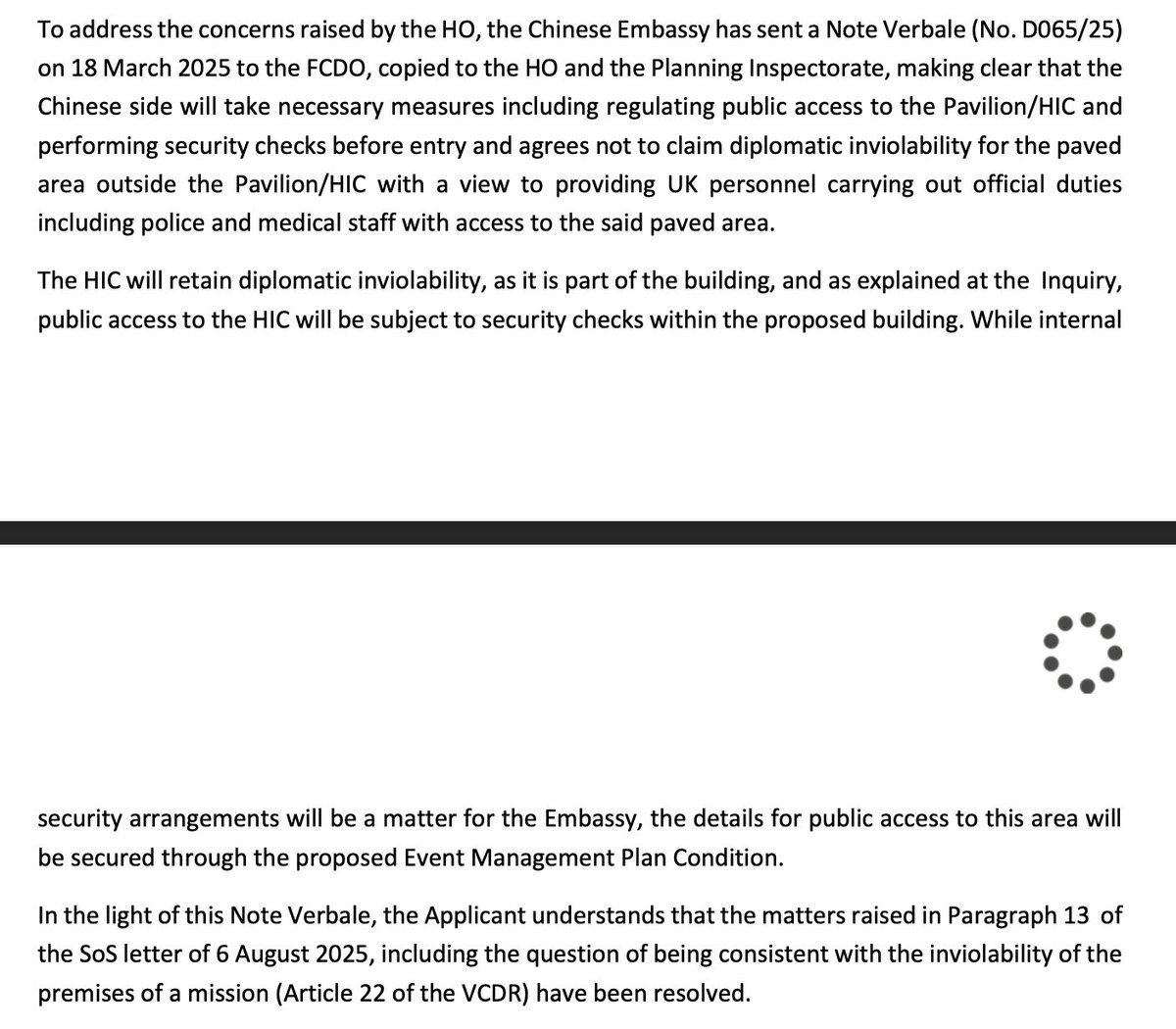
This is complicated, so I won't go into all the detail, but here's the nub: a site of national heritage is under Royal Mint Court (St Mary Grace's, 13th Century Abbey, Edward III commission). Under these plans it will be on Chinese diplomatic land, only accessible with permission of the Head of Mission (the Chinese Ambassador). Back in Jan 25, in the same letter as cited above, the Foreign and Home Secs asked for a "hard perimeter" to be built around the ruins to allow UK emergency services to enter without having to obtain permission. Such a perimeter would have meant that the ruins of the Abbey wouldn't be in diplomatic China. During the Planning Inquiry, the Chinese said, again, "no".
Back in August this was raised again by @AngelaRayner's officials (who have done well throughout, tbh). They asked the Home Office if they were OK with China denying the "hard perimeter" request. Again, more negotiations. The outcome is that China has agreed not to claim a part of the Visitor's Centre as diplomatic land. So far so good....except the ruins will *still* be in diplomatic China (see second image, from DP9, consultants engaged by the Chinese side). The Chinese have also sent the UK a Note Verbale, indicating that they will allow "permanent permission" for anyone to access the ruins.
This fudge does literally nothing to solve the issue surrounding security of access to the ruins. A 'permanent permission' to violate diplomatic inviolability isn't a thing in international law. An area is either diplomatically inviolable, or it's not. Also, as with the consolidation point, the PRC could (and probably will) revoke it at any time. Moreover, as the second image spells out: *access to the ruins will require security checks from Chinese police*.
Safer?? Are you really saying that a Hong Konger with a bounty on their head could access these ruins risk free? A reminder here of Manchester in 2022, where the Chinese Consul General beat up a Hong Konger (Bob Chan), having dragged him into the Consulate grounds.
The Government wants to champion these two *utterly meaningless* compromises, to try to make it seem as if China has been forced to play ball. It's all smoke and mirrors, chaps.
3. The 'sensitive cables is just anti-China scaremongering' argument.
Yes, be prepared to hear some downplaying of the risks associated with the sensitive cabling, first exposed by @Richard_AHolmes in early 2025.
I know for a fact that senior US figures were told that cables "didn't exist" right up until November 2025 when the UK was forced to provide a technical briefing on exposure (which says, you've guessed it: we can deal with the risk, don't worry). Echoes of Huawei.
Here's all you need to know: Barclays Global HQ, Blackrock, Deloitte and others were in the building before it was sold to the Chinese. As reported by the BBC and others, they were using high-capacity cabling. China has a bunch of confirmed infrastructure hacks in the past 18 months in the UK and US. If this *really* doesn't pose a risk, why not be more transparent about it to our allies, and why not set out a mitigation plan?
Judicial review beckons. In the meantime, don't be taken in...
点击图片查看原图
点击图片查看原图

