
China often lectures the world about how Britain “stole” its historical artifacts.
Yet in Nanjing, thousands of palace relics were quietly locked away for decades—some reportedly deteriorating in deep storage, others even sold off.
It is hard to moralize about foreign plunder
时政
(
twitter.com
)
China often lectures the world about how Britain “stole” its historical artifacts.
Yet in Nanjing, thousands of palace relics were quietly locked away for decades—some reportedly deteriorating in deep storage, others even sold off.
It is hard to moralize about foreign plunder when neglect and mismanagement at home are doing the same damage.
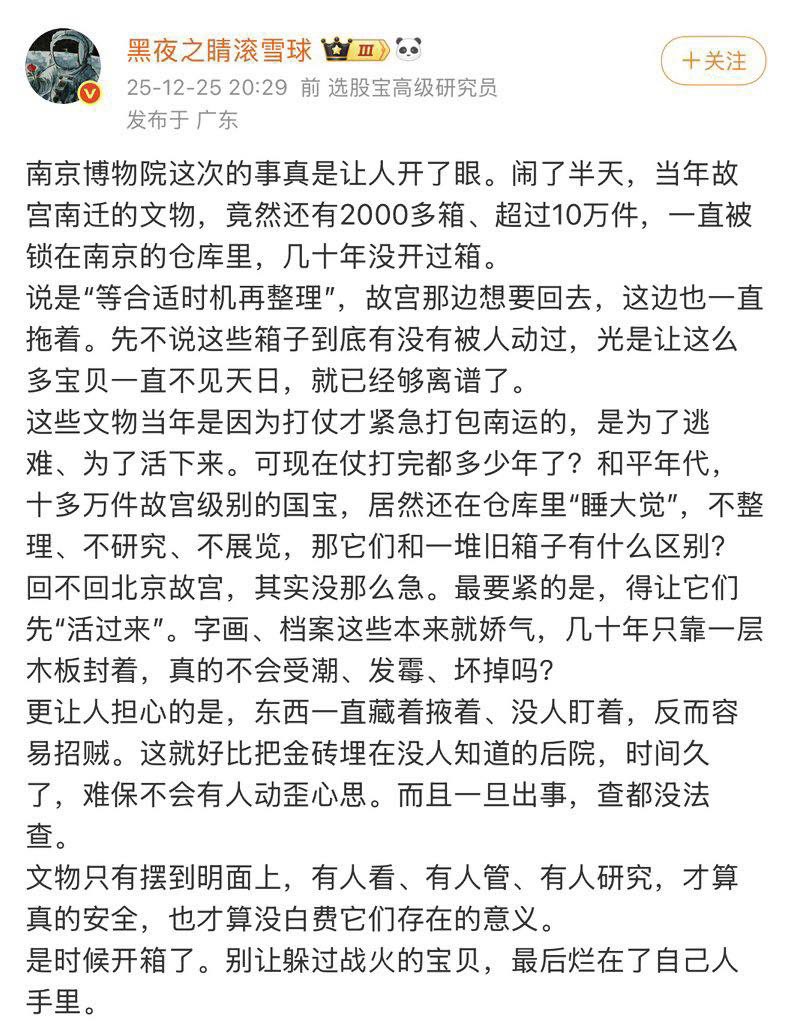
What happened at the Nanjing Museum this time really opened people’s eyes. After causing a stir for half a day, it turns out that more than 2,000 boxes of artifacts from the Palace Museum’s southern relocation—over 100,000 items—have been locked away in Nanjing warehouses, with dozens of years passing without the boxes ever being opened.
The explanation given was “waiting for a suitable time to整理 (organize and process) them.” The Palace Museum wanted them back, but this side kept dragging its feet. Even without discussing whether these boxes were ever tampered with, the mere fact that so many treasures have been kept out of sight for so long is already absurd.
These artifacts were hastily packed and transported during wartime, to escape destruction and to survive. Now, how many decades has it been since the war ended? In an era of peace, more than 100,000 palace-level national treasures are still “sleeping deeply” in warehouses—unorganized, unresearched, unexhibited. In what way are they different from a pile of old boxes?
Whether they are returned to the Beijing Palace Museum is not the most urgent issue. What matters most is that they must first be allowed to “stay alive.” Calligraphy, paintings, and archival materials are inherently delicate. Sealed under just a layer of wooden boards for decades—will they really not suffer from damp, mold, or deterioration?
Even more worrying is that these items have been hidden away for so long with no oversight. Things stored like this are actually more vulnerable to theft. It is like burying gold bricks in an unguarded backyard—given enough time, it is hard to believe no one would be tempted. And once something goes wrong, it would be impossible to investigate.
Only when cultural relics are placed in the open—where people can see them, manage them, and study them—can they truly be considered safe, and only then does their existence have meaning.
It is time to open the boxes. Do not let treasures that survived the flames of war end up ruined by our own hands.
点击图片查看原图

