
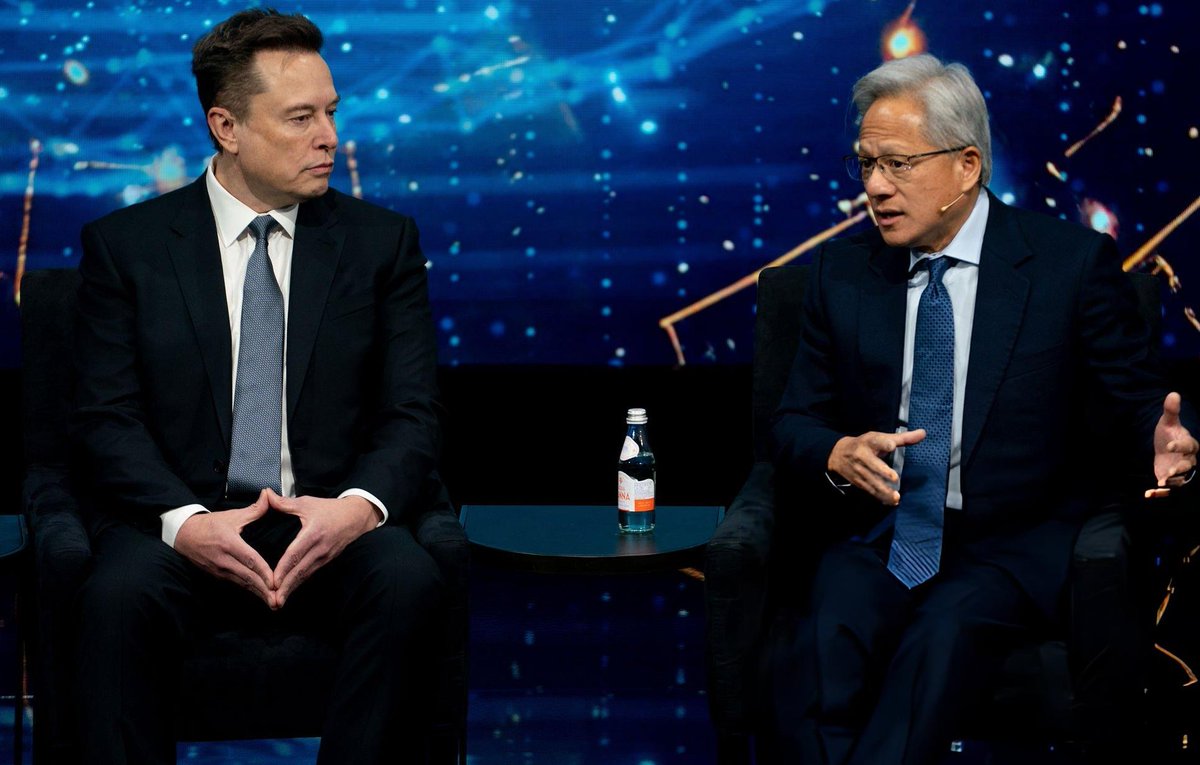
Grok 4.1 summarized the conversation between Elon Musk and Jensen Huang at the US Saudi Investment Forum:
1. Elon Musk on Creation (not just disruption) and the coming age of abundance
Tesla pioneered compelling, affordable EVs (none existed when Tesla started) and slashed
btc
(
twitter.com
)
Grok 4.1 summarized the conversation between Elon Musk and Jensen Huang at the US Saudi Investment Forum:
1. Elon Musk on Creation (not just disruption) and the coming age of abundance
Tesla pioneered compelling, affordable EVs (none existed when Tesla started) and slashed battery costs.
SpaceX invented reusable rockets because throwing away rockets makes space travel prohibitively expensive.
Tesla Optimus will be the world’s first truly useful humanoid robot. Everyone will want one (or many); industry will want millions.
Humanoid robots will become the single largest product category in history — bigger than smartphones or any prior product.
Long-term outcome (10–20+ years): AI + robotics will eliminate poverty globally. Work becomes optional (like choosing to grow your own vegetables for fun). Money itself eventually becomes irrelevant (only physical constraints — energy, atoms — remain).
2. Jensen Huang on the new computing paradigm: From retrieval to generation
Traditional computing was retrieval-based (pre-stored answers, databases, search).
Modern AI is generative: every output is unique, created in real time for each user and context (e.g., every Grok response is different).
This fundamental shift requires “AI factories” distributed worldwide to generate intelligence on demand — exactly what Saudi Arabia is now building (“oil refineries → AI refineries”).
AI is the new foundational infrastructure, like electricity or the internet.
3. Future of jobs and productivity
Elon: In the long run, jobs become optional — something you do for meaning or enjoyment, not necessity.
Jensen (near-term evidence):Radiology has been heavily AI-augmented for years; contrary to predictions, the number of radiologists has increased because AI handles image analysis, allowing doctors to see far more patients and make better diagnoses.
Most knowledge workers will become dramatically more productive → they will pursue more ideas, not less work.
Innovators (like Elon and Jensen themselves) will be busier than ever because AI removes friction from executing backlog ideas.
Historical precedent: every general-purpose technology (steam, electricity, computers, internet) has been massive net job and value creator.
4. Concrete Saudi innovations highlighted
Prof. Omar Yaghi (Saudi-American Nobel laureate in chemistry) used Nvidia-accelerated AI + Grok-like models to design metal-organic frameworks (MOFs) with 3.3 nm pores that pull water and CO₂ from air.
Another Saudi team created 500 × 1,000 nm “nanop” robots using AI-accelerated design + CRISPR to edit out sickle-cell disease genes.
Both breakthroughs were conceived decades ago but only became practical because AI accelerated discovery by orders of magnitude.
5. Major announcements
xAI + Saudi Arabia + Nvidia
xAI will build a 500 MW AI training/inference data center in the Kingdom
AWS partnership: starting 100 MW cluster with gigawatt-scale ambition.
Large-scale rollout of Nvidia Omniverse for digital-twin factories, robotics training, warehouse simulation, etc.
Supercomputers to simulate and control quantum computers (quantum error correction requires enormous classical compute).
6. AI in space — the ultimate scaling solution (Elon + Jensen)
To reach even a tiny fraction of a Kardashev Type II civilization (using >0.0001 % of the Sun’s energy), humanity must put solar-powered AI compute in space.
Earth receives only ~1 part in 2 billion of the Sun’s output; space gives essentially unlimited, continuous solar energy.
Cooling is radiative (no water needed), panels are lighter/cheaper (no glass or framing), no batteries required (always sunny).
Elon’s estimate: Within ~5 years, space-based AI compute will be cheaper than any terrestrial data center.
At hundreds of gigawatts or terawatt scale, terrestrial power generation and cooling become physically impossible (e.g., 300 GW continuous would already consume ~2/3 of total U.S. electricity production).
7. Final question: Is there an AI bubble? (Jensen)
No. Demand is structural and justified by three overlapping waves:End of Moore’s Law → entire industry shifting from CPUs to accelerated computing (6 years ago CPUs were 90 % of Top 500 supercomputers; today <15 %).
Hundreds of billions of dollars of traditional data-processing workloads (SQL, data frames, analytics) moving from CPUs to GPUs.
点击图片查看原图

